

Balance, stamina, doorway width, and the need to sit all change what kind of walking aid feels workable in daily life, so the best rated walkers for seniors are not one single style. A rolling seat can help the person pause during errands, while a basic folding walker can feel steadier in a small room. For a larger older adult, the Helavo 28 stands out on paper because its reinforced aluminum frame is rated for 550 lbs and its seat height adjusts from 20.9 to 22.8 inches. For tight homes, the HOMENURSE Z3 Narrow adjusts from 17.7 to 25.8 inches wide and weighs 6.8 lbs.

Pros
- 550 lb capacity from reinforced aluminum frame
- 22.4 inch handle spacing allows a wider seated position
- Seat adjusts from 20.9 to 22.8 inches high
- 8 inch wheels with reinforced spokes for varied surfaces
- Folds to 37.8 x 28.3 x 13.8 inches for transport
Cons
- 28.3 inch width may feel bulky in narrow hallways
- Extra-wide frame can be harder to lift into a car
- Under-seat basket is less accessible while seated

Pros
- 450-lb capacity with reinforced aluminum frame
- 22-inch padded seat gives larger users room to rest
- 12-inch front wheels handle grass, gravel, and carpet
- Handles adjust from 35.43 to 40.43 inches
Cons
- 32-lb weight may still be heavy for some caregivers
- Large 22-inch seat can feel bulky in tight rooms
- All-terrain wheels may need more trunk space

Pros
- Aluminum frame supports users up to 350 lbs
- 5-inch wheels and 2 skis glide over most floors
- Height adjusts from 32 to 38 inches for fit
Cons
- 5-inch wheels may feel small on rough outdoor paths
- Skis can catch on thick rugs or uneven thresholds

Pros
- 8-inch puncture-proof tires handle varied terrain
- 350 lb capacity supports a wide range of users
- 3-level seat adjusts from 20 to 22 inches
- 22 lb frame is more manageable for transport
Cons
- 22 lb weight may still feel heavy for some caregivers
- Seat range may not fit users outside 4'11"-6'3"
- Must be fully unfolded and locked before each use
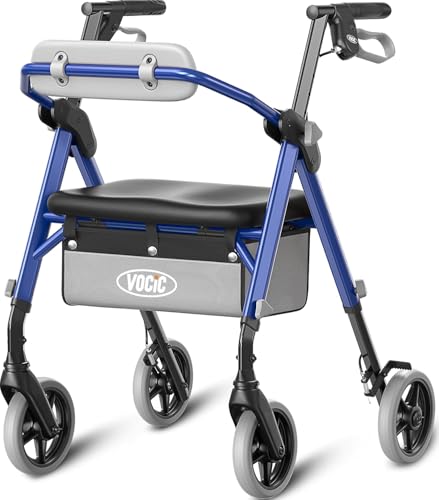
Pros
- 380 lbs capacity for heavier adult users
- Carbon steel multi-triangular frame construction
- 5 handle-height settings from 30.7 to 38.2 inches
- 200,000 high-impact test claim for frame durability
Cons
- Carbon steel frame may feel heavy for car loading
- 30.7 inch lowest handle height may still be tall
- Assembly is required before first daily use

Pros
- 17.7-25.8 inch width helps with tight doorways
- 8 height levels fit users from 5'2" to 6'5"
- Aluminum frame supports up to a 350 lb capacity
- 6.8 lb weight is manageable for transport
Cons
- 5 inch front wheels may feel small outdoors
- Width change requires swapping wheels inside or outside
- Standard walker design lacks a built-in seat
A Closer Look at Our Top Pick
The Helavo 28 is the place I would start for a larger older adult who wants a rollator with a seat and a high listed capacity. Its reinforced aluminum frame is rated for 550 lbs, and the 22.4 inch handle spacing gives the person more room when seated than a narrow frame would. The seat adjusts from 20.9 to 22.8 inches, which gives a caregiver a little flexibility when matching the setup to leg length and comfort. The 8 inch wheels with reinforced spokes also make more sense for varied surfaces than very small front wheels.
The trade-off is size. At 28.3 inches wide, this is not the easiest choice for narrow hallways, small bathrooms, or tight turns near furniture. It folds to 37.8 x 28.3 x 13.8 inches, so it can be transported, but the extra-wide frame may still be awkward to lift into a car. If the person needs a bariatric rollator first and a compact travel aid second, this 550 lb capacity rollator with an adjustable seat is the strongest starting point in this group.
Find Your Situation
- the Helavo 28: suits a larger older adult who needs a 550 lb capacity rollator with 22.4 inch handle spacing. Watch out: the 28.3 inch width may feel bulky in narrow hallways.
- the FlyingJoy Heavy: suits someone who wants a 450 lb capacity rollator with a 22 inch padded seat and 12 inch front wheels. Watch out: the 32 lb weight may still be heavy for some caregivers.
- the Loyoda Folding Walker: suits the person who wants a lighter folding walker rated up to 350 lbs, with height adjustment from 32 to 38 inches. Watch out: the 5 inch wheels may feel small on rough outdoor paths.
- the VOCIC Z21 Rollator: suits an older adult who wants a rollator with an adjustable seat from 20 to 22 inches and support up to 350 lbs. Watch out: the 22 lb frame may still feel heavy for some caregivers.
- the VOCIC Z11 Standard: suits a heavier adult who wants a rollator rated to 380 lbs with 5 handle-height settings from 30.7 to 38.2 inches. Watch out: the carbon steel frame may feel heavy for car loading.
- the HOMENURSE Z3 Narrow: suits small homes because its width adjusts from 17.7 to 25.8 inches and it weighs 6.8 lbs. Watch out: the standard walker design does not include a built-in seat.
How We Narrowed It Down
We compared published specifications rather than handling the products, with the main focus on fit, capacity, width, seat setup, wheel size, folding style, and caregiver effort. We gave extra weight to clear numbers because a 550 lb capacity, a 17.7 inch narrow setting, or a 32 lb product weight changes the shopping decision quickly. We excluded choices that did not give enough practical fit information for an older adult and the family member helping with setup. We also looked for trade-offs, because a 12 inch wheel can help outdoors while taking more trunk space, and a wider seat can help comfort while making tight rooms harder. Before changing the kind of walking aid the person relies on, ask a doctor or physical therapist to check fit, posture, and safe use. The National Institute on Aging notes that movement, vision, medicines, and home setup can all matter in day-to-day safety, so it is worth reading its falls and falls prevention guidance while you plan.
What to Look For
Start with the person, not the walker
A walker that looks right online can still be the wrong match if the person’s height, weight, grip, and rooms do not line up with the specifications. Check listed capacity first, especially if the person is near 350 lbs, 380 lbs, 450 lbs, or 550 lbs. Then look at handle height and seat height, because a seat that starts at 20 inches will feel different from one that starts at 22.8 inches. If there is any doubt, bring the measurements to a clinician who can watch the person stand and turn.
For a top-rated list, compare the hard numbers
Published ratings can be helpful, but the real decision often comes down to numbers that affect fit. For broader comparisons, see walkers for seniors. A 28.3 inch frame may give more room, while a 17.7 inch narrow setting may work better through tight doorways. A 6.8 lb walker is a very different lift than a 32 lb rollator. Treat the listed capacity and dimensions as the first filter, then decide whether a seat, basket, or all-terrain wheel matters most.
Seat or no seat is a daily routine question
A rollator with a seat can help the person pause during longer outings, but it adds size and weight. The 22 inch padded seat on one bariatric rollator gives larger adults more room, while a 20 to 22 inch adjustable seat gives another kind of fit flexibility. A standard folding walker without a seat may be simpler for indoor support and easier to load. If seated breaks are part of errands, consider a rollator with an adjustable 20 to 22 inch seat rather than a basic frame.
Before you buy, measure the tightest doorway
Use the smallest doorway, hallway turn, or bathroom entry as your real test, not the widest room in the home. A 3-wheel walker that adjusts down to 17.7 inches has a different purpose than a rollator that is 28.3 inches wide. Also check the path around the bed, favorite chair, and kitchen table. If the person uses the walker many times each day, 2 inches of extra width can matter more than it seems.
Wheel size should match the usual surfaces
Small 5 inch wheels can be fine for many floors, but they may feel less smooth on rough outdoor paths. Larger 8 inch tires are better suited to varied terrain, and 12 inch front wheels are aimed at grass, gravel, carpet, and similar surfaces. Bigger wheels can also take more trunk space, so the caregiver’s car matters. If most use is indoors, do not overbuy for a surface the person rarely crosses.
Caregivers should think about folding and lifting
Folding style can matter as much as frame weight when one person is loading the walker alone. A 22 lb frame may be manageable for some families, while 32 lbs can feel like a lot at the end of an appointment. A folding walker with trigger release can be easier to store in a corner, while a rollator that folds with all 4 wheels down may be easier to roll toward a trunk. For local help with transportation, home support, or aging services, the Eldercare Locator can connect families by phone at 1-800-677-1116.
When this is not enough, pause and get a fit check
If the person is leaning heavily, has trouble braking, or cannot turn safely in a hallway, a product comparison is not enough. Handle settings such as 30.7 to 38.2 inches or 35.43 to 40.43 inches only help when the posture is right. For posture-focused designs, compare upright walkers. A physical therapist can check whether a rolling walker, standard walker, or another setup fits the person’s strength and routine. This is especially important before choosing a heavier bariatric rollator or a narrow frame for a small home.
Quick Tips for Choosing
- Check weight capacity before looking at color or storage.
- Measure the tightest doorway, not the widest room.
- Compare product weight with who will load it.
- Choose 5 inch wheels for smoother indoor use.
- Choose 8 inch or 12 inch wheels for more varied surfaces.
- Confirm the walker locks open before daily use.
Frequently Asked Questions
Is a rollator better than a standard walker?
It depends on the person’s balance, stamina, hand strength, and home layout. A rollator can include a seat and 4 wheels, while a standard walker can feel simpler in tight indoor spaces. For seated options, compare 4-wheel walkers.
What weight capacity should I choose?
Start with a listed capacity above the person’s current weight, such as 350 lbs, 380 lbs, 450 lbs, or 550 lbs. Do not treat the capacity as the only fit point, because handle height and width still matter.
Are larger wheels always better?
No. A 12 inch front wheel can help on grass, gravel, and carpet, but it may take more trunk space. A 5 inch wheel may be easier for indoor routines on smoother floors.
How important is walker width?
Width is one of the most practical measurements because it affects doorways, bathrooms, and turning space. A 17.7 inch setting and a 28.3 inch frame serve very different homes.
Should my parent get a walker with a seat?
A seat can help if your parent needs planned rests during errands or longer walks. A standard walker without a seat may still be a better fit for short indoor movement and easier storage.
What handle height should I look for?
Compare the person’s height with the listed handle range, such as 32 to 38 inches or 35.43 to 40.43 inches. A clinician can help confirm the right position if the person hunches, reaches, or feels unsteady.
Is a heavier walker safer?
Not automatically. A heavier frame may feel sturdy, but 22 lbs or 32 lbs can be hard for a caregiver to lift into a car.
Can a narrow walker work outdoors?
It can, but look closely at wheel size and surface. A narrow walker with 5 inch front wheels may be more comfortable indoors than on rough outdoor paths.
What should I check when it arrives?
Make sure the frame opens fully, locks as designed, and adjusts to the intended height. If there is a seat, check the seat height and brakes before the person uses it.
How do I choose for a small apartment?
Measure the bathroom door, bed path, and kitchen turn first. A walker that adjusts from 17.7 to 25.8 inches wide may be easier to live with than a wider rollator.
Which One to Start With
If I were helping a family choose from these 6 options, I would start with the main constraint, not the longest feature list. For a larger older adult who needs the highest listed capacity in this group, start with the Helavo 28. Its 550 lb capacity, 22.4 inch handle spacing, and 20.9 to 22.8 inch seat-height range make it the clearest first look for bariatric support, as long as the home can handle a 28.3 inch width.
If the person needs a seat but outdoor surfaces matter more, the 450 lb bariatric rollator with 12 inch front wheels is the better first comparison. It has a 22 inch padded seat and folds with all 4 wheels down, which may help a caregiver roll it toward a trunk instead of carrying its full 32 lbs at once. If the home is small, I would move in the opposite direction and begin with the HOMENURSE Z3 Narrow. Its 17.7 to 25.8 inch adjustable width and 6.8 lb weight are practical advantages in tight rooms, though it does not provide a built-in seat. For many families, the best choice will be the one that matches the person’s body, the narrowest doorway, and the caregiver’s lifting limit at the same time.