

Bending, twisting, and reaching overhead can turn a simple dropped sock or high shelf item into a slow, awkward task, especially when your parent is trying to keep one hand free for balance or support. The best grabber tools for elderly shoppers are not all the same: a 26 inch reach feels very different from a 43 inch reach, and a fixed 32 inch arm stores differently than a folding 13 inch tool. For a straightforward room to room option, the DMI 2 Pack gives you 2 grabbers at 32 inches each, while the EZPIK Pro 36 folds to 13 inches and weighs 10 ounces for easier carrying.

Pros
- 32 inch reach helps with floor and shelf pickup
- 2 pack supports placement in more than 1 room
- 2.5 inch jaw opening grips many household items
- Magnetic tip retrieves light metal objects
Cons
- Non folding design takes more space to store
- 32 inch length may feel awkward in tight spaces

Pros
- 36-inch reach helps access floors and high shelves
- Folds to 13 inches for bags, drawers, or travel
- 10-ounce weight limits hand fatigue during longer tasks
- Silicone 4-inch jaw grips varied shapes and textures
- Dual magnetic tips lift coins, keys, and small metal items
Cons
- 5 lb lift limit may not suit heavier household objects
- 36-inch length can feel awkward in very narrow spaces
- Folding hinge may need checking before each use
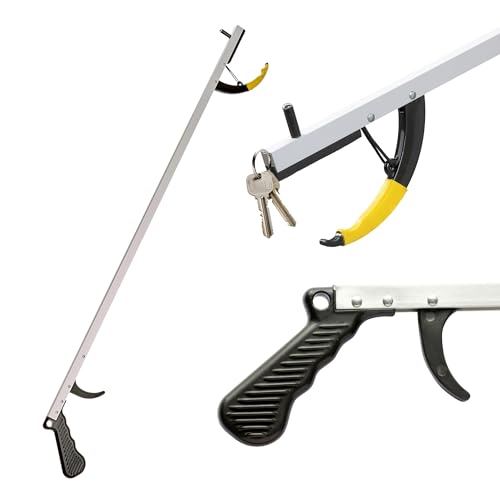
Pros
- 26-inch length helps reach shelves without bending
- Aluminum shaft keeps the tool at 0.25 lb
- 3-inch jaw opening grips varied household items
- Magnetic claw tip lifts keys, nails, and other metal
- Foam rubber tip helps hold uneven shapes securely
Cons
- 26-inch reach may be short for very high shelves
- 3-inch jaw opening will not fit larger bulky items
- 26-inch frame is less compact than shorter reachers

Pros
- 43-inch reach helps access floors and high shelves
- Folds to 17 inches for compact walker storage
- 4-inch wide claw opening handles bulkier items
- Two magnets pick up coins, nails, or batteries
Cons
- 43-inch length may feel awkward in tight rooms
- 5 lb limit is not enough for heavier objects

Pros
- Includes 3 grabbers for rooms, car, or caregiver bags
- 32-inch reach helps access shelves and floor items
- 360° rotating jaw adjusts to different pickup angles
- Magnetic tip can collect small metal items
Cons
- Foldable joints may feel less rigid than fixed reachers
- Trigger grip may still tire hands during long cleanup tasks

Pros
- Adjusts to 5 lengths from 23 to 41 inches
- 4 inch jaw grips cans, bottles, coins, and pills
- 360 degree rotating head reaches awkward angles
- Aluminum alloy frame keeps the tool lightweight
Cons
- 4 lb limit may not suit heavier household items
- 41 inch length may feel bulky in tight rooms
A Closer Look at Our Top Pick
On paper, the EZPIK Pro 36 is the strongest starting point for many households because it balances reach, storage, and hand comfort in a practical way. Its 36 inch length is long enough for floor pickup and many shelves, but it folds to 13 inches, which helps if the person keeps a tool in a drawer, bag, car, or near a favorite chair. At 10 ounces, it is also one of the easier choices to carry from room to room without making every pickup feel like a chore. The silicone 4 inch jaw gives more surface contact than a narrow claw, and the dual magnetic tips are useful for small metal items like coins and keys.
The trade-off is that a longer folding tool asks for a little more attention before each use. The hinge should be checked before reaching, and the 5 lb lift limit means this is for everyday light objects rather than heavy household items. If your parent mainly needs help with socks, mail, remotes, keys, and dropped laundry, a 36 inch folding reacher with a 10 ounce build makes sense. If the tool will stay beside one chair and storage is not a concern, a fixed 32 inch option may feel simpler. Still, the mix of reach, folded size, jaw width, and magnets makes this the easiest first pick for many families.
Find Your Situation
- the DMI 2 Pack: suits a home where 2 rooms need a 32 inch grabber ready for floor and shelf pickup. Watch out: the non folding design takes more space to store.
- the EZPIK Pro 36: suits a person who wants 36 inches of reach, a 13 inch folded size, and a 10 ounce tool for carrying. Watch out: the folding hinge should be checked before each use.
- the Sammons Preston Reacher: suits someone who prefers a shorter 26 inch aluminum tool with a 3 inch jaw for close household pickup. Watch out: the trigger grip can tire hands during repeated pickups.
- the rewkcy 43: suits taller shelves, deep corners, and floor pickup where a 43 inch reach is helpful. Watch out: the extra length can feel awkward in tight rooms.
- the NOEAIKE Grabber Reacher: suits families who want 3 folding 32 inch tools for rooms, a car, or caregiver bags. Watch out: foldable joints may feel less rigid than fixed reachers.
- the FGRHY Telescopic Grabber: suits a person who wants one tool that adjusts from 23 to 41 inches for different tasks. Watch out: the 4 lb limit is not meant for heavier household items.
How We Narrowed It Down
We compared published specifications rather than handling the products, focusing on reach length, folded or storage size, jaw opening, magnetic tips, rotating heads, pack count, tool weight, and stated lift limits. We excluded choices that did not give enough practical detail to compare everyday use, such as reach length or jaw function, because those numbers matter when your parent is picking up items from the floor, a shelf, or under furniture. We also gave less weight to designs that sounded broad but did not clearly explain storage or grip trade-offs. For a person recovering from surgery, managing balance concerns, or changing daily routines, ask a doctor or physical therapist which reach and grip style fits the person best. For general home safety context, the National Institute on Aging explains that simple home adjustments can be part of a broader approach to safer movement at falls and falls prevention.
What to Look For
Start with the reach your parent will actually use
Longer is not always easier. A 43 inch grabber can help with shelves and floor pickup, but it may feel clumsy in a small bathroom or narrow kitchen. A 26 inch tool can be easier to control near a chair, but it may be short for a high shelf. For many homes, the middle range around 32 to 36 inches is the most practical place to begin.
Think about where the grabber will live
A grabber that is always across the room will not help much when something drops. A 2 pack lets you keep one tool in the bedroom and one in the living room, while a 3 pack can cover rooms, a car, and a caregiver bag. Folding designs can be easier to store in a drawer, with one option folding to 13 inches and another to 17 inches. Fixed designs take more space, but they avoid a folding joint.
Match the jaw to common household items
Jaw width matters because the person may pick up soft clothing, a remote, a bottle, or a small package in the same day. A 3 inch jaw can handle many everyday objects, while a 4 inch jaw gives more room for bulkier items. Silicone or foam tips can help with varied shapes and textures. If your parent often picks up cans, bottles, coins, or pills, an adjustable reacher with a 4 inch rotating jaw is worth a close look.
Magnets are helpful, but only for the right jobs
A magnetic tip is useful for small metal items such as keys, coins, nails, or batteries. It will not replace the claw for fabric, paper, plastic, or heavier household objects. Several options include 1 or 2 magnets, which can save a slow bend for a dropped key. Treat the magnet as a convenience feature, not the main reason to buy.
For older hands, weight and trigger effort matter
A light grabber is easier to hold during repeated pickups. The 10 ounce folding model is a good example of why weight belongs in the decision, especially if the person plans to carry it around the home. Trigger grips can still tire hands during long cleanup tasks, even when the shaft is lightweight. If hand fatigue is common, consider kitchen tools like air fryers for seniors that reduce bending and reaching, and keep a second grabber close by.
Before you buy, picture 3 real tasks
Choose based on what your parent reaches for most often, not on the longest number. For example, socks beside the bed, a can from a low shelf, and keys near the door may point to a 32 inch tool with a magnetic tip. If the person needs to reach under furniture, a rotating jaw can help with awkward angles. If the tool travels in a bag or car, a folded size of 13 or 17 inches matters.
When this is not enough, get local help
A grabber is only one tool, and it should not be asked to solve every reach, balance, or home setup problem. If your parent needs help changing room layout, finding local aging services, or planning support at home, Eldercare Locator can connect families with local resources by phone at 1-800-677-1116. A grabber with a 5 lb or 4 lb limit should not be used for heavy objects. When reach, strength, or balance questions keep coming up, a professional home assessment may be more useful than buying another tool.
Quick Tips for Choosing
- Choose 26 inches for close control near a chair or bed.
- Choose 32 to 36 inches for general floor and shelf pickup.
- Choose 41 to 43 inches only if the extra reach fits the room.
- Pick folding storage if the tool needs to fit in a bag or drawer.
- Look for a 4 inch jaw if bottles, cans, or bulkier items are common.
- Respect 4 lb and 5 lb limits for light household pickup only.
Frequently Asked Questions
What length grabber is easiest for many older adults?
A reach around 32 to 36 inches is often the easiest starting range because it helps with floors and many shelves without being as long as 43 inches. A shorter 26 inch tool may feel steadier for close pickup near a chair.
Is a folding grabber better than a fixed grabber?
A folding grabber is better for storage, travel, or keeping in a car because some fold to 13 or 17 inches. A fixed grabber may feel simpler because it does not have a folding hinge to check.
Can a grabber pick up keys or coins?
Yes, if it has a magnetic tip or dual magnetic tips, it can help with small metal items such as keys, coins, nails, or batteries. The claw is still needed for nonmetal items like socks, paper, or plastic bottles.
What jaw width should I look for?
A 3 inch jaw can handle many everyday items, while a 4 inch jaw gives more room for larger or oddly shaped objects. If the person often picks up cans, bottles, or folded clothing, the wider jaw may be easier.
Are longer grabbers harder to control?
They can be, especially in narrow spaces. A 41 or 43 inch grabber reaches farther, but that extra length can feel bulky in tight rooms.
How much weight can these tools lift?
Some options list a 4 lb or 5 lb limit, so they are meant for light household items. They should not be used for heavy objects, full bags, or anything that would be unsafe if dropped. For tasks involving food preparation, a dedicated jar opener for seniors may be easier than a grabber.
Do rotating jaws matter?
A rotating jaw can help when reaching under furniture, into corners, or toward an object at an awkward angle. A 360 degree rotating head gives more positioning choices than a fixed claw.
Should I buy more than 1 grabber?
More than 1 can be helpful if your parent spends time in several rooms. A 2 pack or 3 pack lets the person keep a grabber near the bed, favorite chair, kitchen, car, or caregiver bag.
Can a grabber help with dressing?
Some reachers are described as dressing tools and may help pull light clothing closer. The right fit depends on the person, the clothing, and whether a 26, 32, or 36 inch reach feels controllable.
What should caregivers check before use?
Check that folding joints are locked, the jaw opens and closes smoothly, and the tip is aligned with the item. Also remind the person to keep the object light, especially when the tool has a 4 lb or 5 lb limit.
Which One to Start With
If you want one first choice for a typical home, start with the EZPIK Pro 36. Its 36 inch reach covers most floor and shelf tasks, the 13 inch folded size makes storage easier, and the 10 ounce weight is friendly for carrying from room to room. The 4 inch silicone jaw and dual magnetic tips also give it enough flexibility for common items like keys, coins, remotes, socks, and light household objects. The main caution is the 5 lb limit, so it belongs in light daily pickup, not heavy lifting.
If your parent dislikes folding hinges or wants a tool that can stay beside a chair, choose a 2 pack of fixed 32 inch grabbers instead. Having 2 tools means fewer trips across the room, and the 2.5 inch jaw opening is enough for many smaller household items. If reach is the main challenge and the rooms are open enough, the rewkcy 43 is the long option to consider, with 43 inches of reach and a 4 inch wide claw. For changing tasks in different rooms, the telescopic 23 to 41 inch style is appealing, but its 4 lb limit keeps it in the light-duty category. The best first purchase is the one that matches the 3 places your parent reaches most often.