

Reaching across a dining table, gathering pieces into bowls, and clearing space before dinner can turn a relaxing puzzle into a setup problem. The best jigsaw puzzle tables solve that by giving the person a steady surface, sorting drawers, and height or tilt options that fit a favorite chair. After comparing the published specifications for 6 options, the JoyBerri Jigsaw Puzzle stands out for its 9 height settings, 45-degree tilt, locking wheels, and felt top. If your parent wants a larger 1500-piece surface, the ALL4JIG 1500 Pieces adds a 24.92 x 33.58 inch board, 4 drawers, and a 0° to 90° tilt range.

Pros
- 9 height settings adjust from 21 to 37 inches
- 45-degree tilt helps reduce reaching across the puzzle
- 4 magnetic drawers keep pieces sorted by section
- Felt surface helps keep loose pieces from sliding
Cons
- Tilted top may not suit users who prefer a flat table
- Wheels need locking before working to limit table movement
- Large workstation may be awkward in small living spaces

Pros
- 9 height levels support chairs, sofas, or standing
- 45° tilting felt surface helps keep pieces in view
- 4 magnetic drawers keep sorted pieces contained
- Includes a 1000-piece puzzle and protective cover
Cons
- 37 inch maximum height may be low for taller standing users
- Felt surface can collect lint, crumbs, and pet hair
- Tilting top may still need care with loose edge pieces

Pros
- 360° rotating board limits awkward reaching around
- New Zealand pine surface for puzzles and crafts
- 4 drawers keep pieces and tools separated
- 0° to 90° angle range supports sitting or standing
- 24.92 x 33.58 inch top fits many 1500-piece puzzles
Cons
- Large tabletop may crowd small rooms or narrow hallways
- Wheels can be less stable on thick carpeted floors
- Vertical setup may take practice to adjust smoothly

Pros
- 35.43 x 27.87 inch surface fits 1500 pieces
- Metal frame with pneumatic tilt for angle changes
- Adjusts from 22.16 to 33.27 inches high
- Wooden board includes 4 drawers and a cover
Cons
- Large footprint may crowd smaller living rooms
- Cover helps, but spills can still reach edges
- 1500-piece size may be too big for casual puzzles
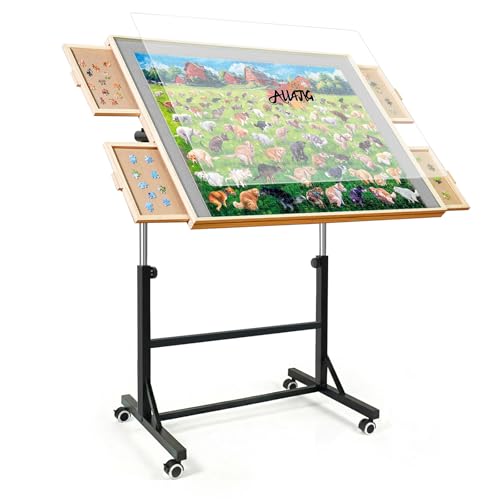
Pros
- 4 drawers help sort pieces by color, edge, or pattern
- New Zealand pine offers a smooth puzzle surface
- 0° to 90° tilt supports puzzles, crafts, or laptop use
- 4 caster wheels make room-to-room moves simpler
Cons
- 24.92 by 33.58 inch top may crowd larger puzzles
- Tilting surface could shift loose pieces at steeper angles
- Drawers add sorting space but also increase cleanup steps

Pros
- Built-in magnifier supports viewing 1500-piece details
- 6 sorting drawers keep edge and color pieces separated
- All-metal tabletop and frame add durable support
- 1500-piece surface with adjustable height and tilt
Cons
- Large 1500-piece size may crowd smaller rooms
- All-metal construction may feel heavy to reposition
- 6 drawers need clearance to open fully
A Closer Look at Our Top Pick
The JoyBerri Jigsaw Puzzle earns the first look because its published specifications line up well with everyday puzzle habits in a shared home. Its 9 height settings cover 21 to 37 inches, which gives more room to match a sofa, armchair, or standing position than a fixed board on a dining table. The 45-degree tilt can help keep the picture closer to the person’s line of sight, and the felt surface is meant to help loose pieces stay put during breaks.
The practical details matter just as much as the puzzle surface. This table has 4 magnetic drawers, so edge pieces, sky pieces, faces, or color groups can stay separated instead of being spread across the room. Locking wheels make it easier for a caregiver to move the workstation aside, but the wheels should be locked before puzzle time so the table feels settled. The main trade-off is size: a large workstation can be awkward in a tight living room, especially if the person needs clear walking paths around furniture.
Find Your Situation
- the JoyBerri Jigsaw Puzzle: Best fit if your parent wants a flexible workstation with 9 height settings from 21 to 37 inches, 4 magnetic drawers, and a felt top. Watch out: the tilted top may not suit someone who prefers a fully flat puzzle surface.
- the JoyBerri Jigsaw Puzzle: Good fit if the person wants a 1000-piece setup with 9 height levels, a protective cover, and 4 magnetic drawers. Watch out: the 37 inch maximum height may feel low for a taller person who wants to stand.
- the ALL4JIG 1500 Pieces: Best fit if your parent wants a larger 24.92 x 33.58 inch surface, 360° board rotation, and a 0° to 90° angle range. Watch out: the larger top may crowd narrow halls or small rooms.
- the HEBESPACE 1500: Good fit if the person wants a 35.43 x 27.87 inch wooden board with 4 drawers, a cover, and pneumatic tilt on a metal frame. Watch out: the 1500-piece size may be more table than a casual puzzler needs.
- the ALL4JIG 1500 Pieces: Good fit if your parent wants one movable surface for puzzles, bricks, crafts, or a laptop, with 4 caster wheels and 4 drawers. Watch out: loose pieces can shift at steeper angles.
- the OIRBOEUS Puzzle: Best fit if the person wants 6 sorting drawers, an all-metal frame, and a built-in magnifier for checking small 1500-piece details. Watch out: the metal build may feel heavy to reposition.
How We Narrowed It Down
We compared published specifications rather than handling these puzzle tables in person. The main factors were height range, tilt range, drawer count, puzzle capacity, tabletop size, surface material, wheels, covers, and whether the design made sense near a chair or sofa. We excluded products from consideration when the information did not clearly support seated puzzle work, sorting, or storage during breaks. We also gave more weight to designs with at least 4 drawers, because sorting is one of the main reasons families move beyond a plain board. If your parent has pain, balance concerns, or a recent change in mobility, ask a doctor or physical therapist what table height and chair setup make sense; the National Institute on Aging also offers practical home-safety guidance on falls and falls prevention without making a puzzle table the whole answer.
What to Look For
Start with the chair, not the table
The right table depends on where the person actually puzzles. A height range like 21 to 37 inches gives more room to match a sofa, recliner, dining chair, or standing position. If your parent keeps returning to 1 favorite chair, measure from the floor to the armrest and think about knee clearance. A table that fits the room but not the chair will still feel awkward.
Choose tilt for comfort, then keep it modest
Tilt can make the picture easier to see without leaning over the whole board. A 45-degree tilt is enough for many seated puzzlers, while a 0° to 90° range gives more flexibility for crafts or vertical viewing. Steeper angles can ask more from loose pieces, especially along unfinished edges. If the person likes to sweep pieces around by hand, a flatter setting may feel calmer.
Make drawers match the way the person sorts
Four drawers are enough for many puzzle habits: edge pieces, bright colors, dark colors, and uncertain pieces. Six drawers give more separation, which can help when the image has many similar shades, especially with puzzles for dementia patients. More drawers also mean more places to check before calling a piece lost. For a person who likes a simple routine, 4 drawers may be easier than 6.
Check the puzzle size before you choose a surface
A 1000-piece puzzle often needs less room than a 1500-piece puzzle, but box shapes vary. A 24.92 x 33.58 inch top or a 35.43 x 27.87 inch top gives a larger working area for spreading sections. The trade-off is that a larger board takes more space beside a sofa or in a living room. If the person mostly enjoys Disney puzzles or smaller puzzles, a 1500-piece table may feel oversized.
Before you buy, map the route through the room
Wheels are helpful only if the table can move where it needs to go. Measure the path from the storage spot to the puzzle spot, especially around doorways, rugs, and chair legs. A model with 4 caster wheels can be easier to reposition, but wheels should be locked before puzzle time. Thick carpet can make wheeled tables feel less settled than hard flooring.
Think about the surface your parent will touch every day
Felt can help loose pieces resist sliding, which is useful during short breaks. It can also collect lint, crumbs, or pet hair, so it may need regular brushing. Wood surfaces, including New Zealand pine on some tables, can feel smooth for puzzles and crafts. All-metal construction may add durable support, but it may also feel heavier when the table is moved.
When this is not enough, look beyond the table
A puzzle table can organize pieces, but it cannot solve every setup challenge in the room. If your parent needs help with transportation, home support, or local aging services, the Eldercare Locator can connect families with resources by phone at 1-800-677-1116. Keep the puzzle area simple, with 1 clear chair, 1 lamp, and a table that does not block common walking routes. Small changes around the table can matter as much as the table itself.
Quick Tips for Choosing
- Pick 21 to 37 inches if several chairs may be used.
- Choose 4 drawers for simple sorting and 6 for finer sorting.
- Use a cover if the puzzle often stays out between sessions.
- Lock wheels before the person starts working.
- Choose 1500-piece capacity only if the room has space.
- Keep tilt gentle when many loose edge pieces are on the board.
Frequently Asked Questions
Is a puzzle table better than a regular card table?
A puzzle table usually adds features a card table does not, such as 4 drawers, a cover, tilt, or adjustable height. For other activities like escape room games, a card table can work for short sessions, but it does not keep sorted pieces or game components contained as neatly.
What height is best for seated puzzling?
The best height depends on the chair, the person’s posture, and how close the table sits to the body. A range such as 21 to 37 inches gives more flexibility than a fixed-height surface.
Are wheels a good idea on a puzzle table?
Wheels help when a caregiver wants to move the table from a living room to a corner. For puzzle time, the wheels should be locked so the surface does not shift while the person works.
How many drawers does a puzzle table need?
Four drawers are enough for many people because they support broad sorting by edge, color, or pattern. Six drawers can help with larger 1500-piece puzzles that have many similar areas.
Does a tilted puzzle surface make pieces slide?
It can, especially at steeper angles or when many edge pieces are loose. Felt surfaces and careful angle choices can help, but a flat setting may be better for someone who moves pieces often.
Is a 1500-piece puzzle table too large?
It depends on the room and the person’s puzzle habits. A 1500-piece surface gives more room to spread out, but it can crowd small living rooms or narrow paths.
Should I choose felt, wood, or metal?
Felt helps pieces resist sliding, while wood can feel smooth for puzzles and crafts. Metal frames or tabletops can add support, but they may feel heavier when repositioning the table.
Is a cover worth having?
A cover is useful when a puzzle stays out for several days or when the table sits in a shared room. It can help protect the work surface, though spills near the edges still need care.
Can one table work for puzzles and crafts?
Yes, some tables are described for puzzles, bricks, crafts, laptop tasks, or drafting. If the person will switch activities, look for adjustable height, tilt, and at least 4 drawers for supplies.
What should family caregivers check first?
Start with the room layout, chair height, and how often the table needs to move. Then compare drawer count, tabletop size, and tilt range before choosing a 1000-piece or 1500-piece setup.
Which One to Start With
If you want the safest first choice on paper for most older adults, start with the JoyBerri Jigsaw Puzzle. Its 9 height settings, 21 to 37 inch range, 45-degree tilt, 4 magnetic drawers, locking wheels, and felt top cover the everyday needs families usually ask about first: seated comfort, sorting, and the ability to move the table aside between sessions. It is the one I would consider first when your parent enjoys 1000-piece puzzles, works from a favorite chair, and wants a dedicated station without jumping to the largest surface.
If the person already prefers bigger puzzles, move to a 1500-piece table with a 360° rotating board. The 24.92 x 33.58 inch top, 4 drawers, wheels, and 0° to 90° tilt make sense for someone who spreads sections widely and may want to rotate the work instead of reaching across it. Choose it only if the room can handle the larger footprint.
For a parent who likes detailed sorting and wants help checking small pieces while seated, consider the OIRBOEUS Puzzle. Its 6 drawers and built-in magnifier are the clearest reasons to choose it over simpler 4-drawer tables. Just plan for the all-metal construction and make sure the drawers have room to open fully.