

Reaching for a drink, book, meal tray, or laptop from bed can become awkward when the surface is too far away, too low, or hard to move without help. The best over bed tables with wheels solve that by bringing a steady work or meal surface closer, then rolling aside when the person needs room. After comparing 6 options on paper, the KOMOREBI Overbed stands out for its 24 to 35 inch height range, 32 to 47 inch width span, and 4 locking casters. For a much wider bed setup, the MAHANCRIS Overbed Table gives a 70.9 inch span that can cross twin or queen beds.

Pros
- 24-35 inch height range fits different bed setups
- 32-47 inch width span can bridge a single bed
- 5 tilt settings support reading or laptop viewing
- Wood top and steel frame are rated up to 350 lb
- 4 locking casters roll between bed, sofa, and recliner
Cons
- 47 inch maximum span may not fit larger beds
- Tilting section may be awkward for full meal trays
- 350 lb rating does not mean it is safe to lean on

Pros
- 70.9-inch length spans twin and queen beds
- 36.4-43.5 inch height range for bed clearance
- 10-angle tilt stand supports reading or laptop use
- Particleboard and metal frame with four casters
Cons
- 70.9-inch width may be bulky in small bedrooms
- Two-person assembly may be difficult for some households

Pros
- 28 to 41 inch pneumatic height adjustment range
- 2 lockable wheels plus 2 swivel wheels for movement
- Heavy-duty steel frame supports up to 150 lbs
- Waterproof, scratch-resistant surface wipes clean
- FSC-certified wood tabletop for household use
Cons
- 28 by 16 inch top may feel tight for larger meals
- Only 2 of the 4 wheels lock in place
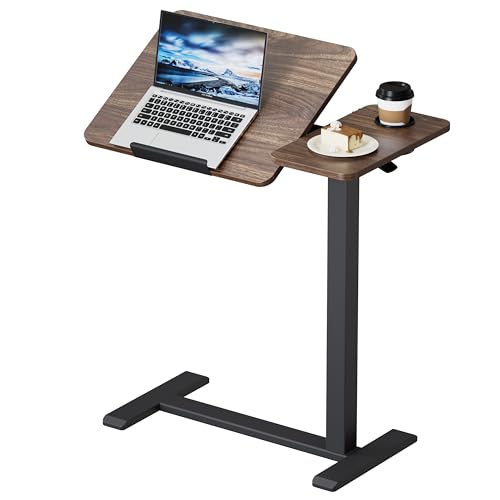
Pros
- Tilting desktop adjusts from 0° to 70° for reading
- 29.7 to 43.3 inch height range supports varied seating
- 4 hidden wheels make it easier to reposition bedside
- Rounded corners and 22 lb static load capacity
Cons
- 22 lb static load may limit heavier equipment
- Hidden wheels may roll less smoothly on thick carpet
- Tilted top can be awkward for open cups or soup

Pros
- 360° swivel tray reaches from several seating angles
- Thicker steel frame supports daily laptop or snack use
- Wood tabletop is heat resistant and water resistant
- 360° rotation helps caregivers position the tray
Cons
- Concave tabletop may limit use with larger flat items
- Wheels can drift if placed on slick flooring

Pros
- 28-inch surface supports meals, reading, or laptop use
- Cold-rolled steel frame supports up to 22 lbs
- 360-degree cup holder mounts on either side
- 4 hidden casters help it roll between rooms
Cons
- 22-lb limit may not suit heavier monitors or gear
- Side-mounted leg may feel awkward beside some chairs
A Closer Look at Our Top Pick
The KOMOREBI Overbed is the first place we would look for many households because it balances reach, adjustability, and locking movement without becoming as wide as a room-spanning table. Its 24 to 35 inch height range can work across several bed, sofa, recliner, or wheelchair setups, while the 32 to 47 inch width span can bridge a single bed. That matters when your parent wants a book, tablet, meal, or laptop close enough to use without twisting across a nightstand. The wood top and steel frame are rated up to 350 lb, but that number should be read as a load rating, not permission to lean on it for balance.
The tilt feature is also useful, with 5 settings for reading or laptop viewing. A tilted surface can make a screen easier to see, but it may be less convenient for soup, open cups, or a full tray. The 4 locking casters are a practical detail because caregivers often need to roll a table from bed to sofa or recliner and then hold it in place. If the person has a larger bed, the 47 inch maximum span may be too narrow, so measure across the mattress and frame before choosing a 32 to 47 inch bridging table.
Find Your Situation
- the KOMOREBI Overbed: suits a single bed, sofa, recliner, or wheelchair area where a 24 to 35 inch height range and 32 to 47 inch span are enough. Watch out: the 47 inch maximum span may not fit larger beds.
- the MAHANCRIS Overbed Table: suits twin or queen beds where a 70.9 inch rolling surface is more helpful than a small side table. Watch out: that same 70.9 inch length may feel bulky in a small bedroom.
- the GTPLAYER Small Standing: suits someone who wants a compact 28 by 16 inch surface with pneumatic height adjustment from 28 to 41 inches. Watch out: only 2 of the 4 wheels lock.
- the BIZUM BZIUM: suits bedside reading or laptop use where a 27.6 by 15.8 inch top and 0° to 70° tilt are helpful. Watch out: the 22 lb static load limit may not suit heavier equipment.
- the SJIE C Table: suits a bed, couch, chair, or bathtub area where a 360° swivel tray can reach from different angles. Watch out: the concave tabletop may limit larger flat items.
- the HUANUO 28Inch Bedside: suits meals, reading, or laptop use on a 28 inch surface with a side-mounted 360-degree cup holder. Watch out: the 22 lb limit may not suit heavier monitors or gear.
How We Narrowed It Down
We compared published specifications rather than handling the products, focusing on height range, tabletop size, wheel design, lockability, tilt, stated load rating, and where each table is meant to sit. We excluded options that did not clearly describe rolling use, bedside positioning, or a practical surface for meals, reading, or a laptop. We also gave less weight to tables that sounded useful but did not offer a clear number for height, surface size, span, or load. For households concerned about transfer habits, standing support, or room layout, ask a doctor or physical therapist before relying on any table as part of a daily setup. The National Institute on Aging notes that home safety and everyday movement deserve careful attention in falls and falls prevention, and a rolling table should be placed so it helps access without becoming something to lean on.
What to Look For
Start with the bed width, not the photo
A table that looks right online can be wrong if the span does not match the bed. A 32 to 47 inch table can work for a single bed setup, while a 70.9 inch table is aimed at wider twin or queen arrangements. Measure the mattress, frame, and any side rail before choosing a bridging style. If the table only needs to sit beside the bed, a 28 inch top may be easier to live with.
Check the height at the surface your parent actually uses
Height range matters because beds, recliners for seniors, sofas, and wheelchairs do not sit at the same level. A 24 to 35 inch range is useful for lower setups, while 36.4 to 43.5 inches gives more clearance for taller beds. Pneumatic ranges such as 28 to 41 inches can be easier to change than knob-based adjustments for some households. Measure from the floor to the top of the mattress or cushion before buying.
Think about wheels and locks as a daily habit
Wheels are helpful only if the table rolls where it needs to go and stays put once placed. Some options have 4 locking casters, while another has 2 lockable wheels plus 2 swivel wheels. Hidden casters can make a table look tidier, but thick carpet may make movement less smooth. If the floor is slick, check that the table can be positioned without drifting during meals or reading.
Decide whether tilt helps or gets in the way
Tilt can be excellent for reading, laptop viewing, or tablet use. One table offers 5 tilt settings, while another has a 0° to 70° tilting desktop. The trade-off is that tilt is less friendly to open cups, soup, or a full plate. If meals are the main use, a flatter surface may matter more than the reading angle.
Before you buy, match the load rating to the job
Load ratings are not all the same, and they should not be treated as support ratings for a person. One steel-frame table is rated up to 350 lb, while compact models list 150 lbs or 22 lbs. A 22 lb limit may be fine for a light meal or book, but not for heavier gear. If your parent tends to push down when standing, choose another support strategy rather than relying on the table.
When this is not enough for the room
A rolling table is a surface, not a full room solution. If the person needs help arranging furniture, comparing local support options, or finding aging services, the Eldercare Locator can connect families with local resources by phone at 1-800-677-1116. In smaller rooms, a 70.9 inch table may block paths even if it fits the bed. In tighter spaces, a compact 28 by 16 inch rolling desk may be easier to move around.
Look at the surface shape, not just the size
A flat rectangular top is simplest for plates, books, and laptops. A concave tabletop or raised edge can help contain snacks and drinks, but it may limit larger flat items. A side-mounted cup holder can free up the 28 inch surface, though it may not suit every chair angle. For reading-heavy use, a 27.6 by 15.8 inch tilt top may be more useful than a wider flat tray.
Quick Tips for Choosing
- Measure bed width before choosing a table that bridges the mattress.
- Measure floor-to-surface height at the bed, recliner, or chair.
- Choose 4 locking casters if repositioning and steadiness matter most.
- Choose a flat top for meals with open cups or bowls.
- Choose tilt for reading, tablets, or laptop viewing.
- Keep load ratings for objects, not body support.
Frequently Asked Questions
Can an over bed table be used as a standing aid?
No table here should be treated as a standing aid. A load rating, even one as high as 350 lb, refers to the table’s stated capacity for items, not body support.
What size top works best for meals?
A 28 inch surface can handle many basic meals, but a larger tray may feel crowded on a 28 by 16 inch top. If meals include several dishes, favor a flat surface over a tilted one.
Is a wider table always better?
Not always. A 70.9 inch span can be helpful across a twin or queen bed, but it may be awkward in a narrow bedroom.
Are hidden wheels better than exposed casters?
Hidden wheels can look cleaner and help the table move between rooms. On thick carpet, they may not roll as smoothly as larger exposed casters.
How many wheels should lock?
More locking points usually make positioning feel more controlled. A table with 4 locking casters may stay steadier than one where only 2 wheels lock.
When does tilt make sense?
Tilt makes sense for reading, tablet viewing, or laptop work. It is less convenient for open cups, soup, or anything that can slide.
What height range should I choose?
Match the range to the actual bed or chair height. Options here range from 24 inches at the low end to 43.5 inches at the high end.
Can one table work for bed and recliner use?
Yes, if the height range and leg design fit both locations. A table designed for bed, sofa, recliner, or wheelchair use gives more placement flexibility with pressure relief cushions.
Is a cup holder worth it?
A 360-degree cup holder can keep a drink off the main surface and mount on either side. It may be less helpful if the side-mounted leg conflicts with the chair or bed frame.
What should caregivers check first?
Check the path where the table will roll, the height at the bed or chair, including any seat cushion, and the way the person reaches for items. Those 3 checks matter more than appearance.
Which One to Start With
If you want the safest starting point for an ordinary single-bed, recliner, sofa, or wheelchair-adjacent setup, start with the KOMOREBI Overbed. Its 24 to 35 inch height range is broad enough for many lower surfaces, and the 32 to 47 inch span gives it more reach than a small side cart. The 4 locking casters are also a practical advantage when a caregiver needs to roll it in for a meal, then move it aside.
If your parent uses a twin or queen bed and wants a table that reaches across the mattress, choose the 70.9 inch overbed table instead. It is the better fit when width is the main problem, especially if the person wants books, a laptop, and a meal surface spread out. The trade-off is room space, so measure the path beside the bed before committing.
For a smaller bedroom, apartment, or chair-side setup, a compact pneumatic option makes more sense. the GTPLAYER Small Standing gives a 28 by 16 inch surface and adjusts from 28 to 41 inches, which is useful when the table needs to move between sitting and standing-height tasks. If the main use is reading in bed rather than meals, consider a tilt-focused design, but keep open drinks on a flat surface.