

Small changes in band shape, grip style, and tension can decide whether a home exercise routine feels simple or frustrating. The best resistance bands for seniors are usually the ones that match the person’s hands, chair setup, skin sensitivities, and current strength level, rather than the set with the biggest resistance claim. A person who wants seated moves may do better with the Healthy Seniors Chair, while someone who wants latex-free flat bands for stretching may prefer the Renoj Pilates Flexbands. After comparing 6 sets on paper, we looked for clear resistance options, manageable grip choices, simple storage, and enough guidance for a family member to help without overcomplicating the routine.

Pros
- Latex-free TPE may feel gentler on sensitive skin
- 5 bands marked from 5 to 30 lbs for progression
- Combines bands for up to 80 lbs resistance
Cons
- Flat bands lack handles for users with weak grip
- Latex-free TPE can roll or bunch during leg work

Pros
- Includes 2 natural rubber bands for varied tension
- Natural rubber bands have soft handles for gentler grip
- 2 follow-along formats: chart and video access
- 2 resistance levels support arms, legs, and core
Cons
- Seated format may feel too limited for active exercisers
- Natural rubber may bother people with latex sensitivity
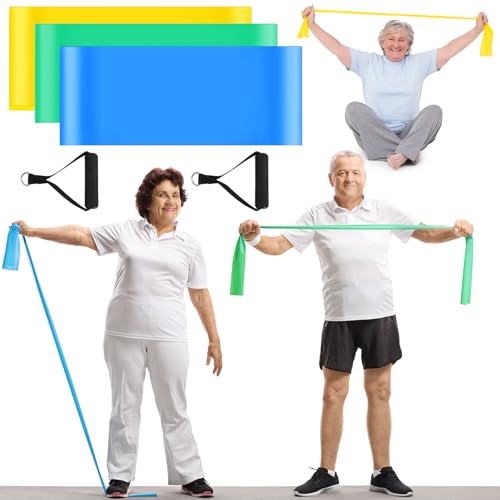
Pros
- Includes 3 bands for rotating resistance levels
- 59-inch length supports seated arm and leg moves
- TPE bands offer stretch with a softer feel
- Foam handles improve grip during chair routines
Cons
- Only 2 handles, so bands must be swapped between colors
- Thin bands may feel too light for stronger users
- Latex-like TPE may bother some sensitive users

Pros
- 5 resistance levels support gradual progression
- 12 by 2 inch loops fit stretching and strength work
- Carry bag keeps all 5 bands together for travel
- 5-band set includes a printed instruction guide
Cons
- Loop style may not suit seated users needing handles
- 12 by 2 inch bands can roll or pinch during moves

Pros
- 5 bands adjust from 10 to 50 lb individually
- Stacks multiple tubes for up to 150 lb resistance
- Natural latex bands with steel metal buckles
- Includes 2 cushioned handles and 1 door anchor
Cons
- Door anchor requires a solid, closed door nearby
- Latex may not suit people with latex sensitivity
- 150 lb setup may feel excessive for gentle routines

Pros
- Includes 3 color-coded resistance levels
- Latex-free rubber suits latex-sensitive users
- Each band measures 5 ft by 6 inches wide
- Includes illustrated guide with 12 exercises
Cons
- X-heavy band may be too much for some beginners
- Flat bands require hand wrapping for secure grip
A Closer Look at Our Top Pick
The Renoj Pilates Flexbands stand out as the easiest starting point for many households because the set gives a broad but understandable path: 5 marked bands ranging from 5 to 30 lbs. That matters when your parent is not sure what feels right yet, or when a caregiver wants to keep the routine gentle at first. The flat, latex-free TPE design also makes sense for stretching, Pilates-style moves, and light strength work where handles are not needed. Since the bands roll up, they are simple to keep in a drawer or bring along when the person spends time in more than 1 home.
The trade-off is grip. Flat bands can be wrapped around the hands, but they do not give the same secure hold as foam or cushioned handles. They can also roll or bunch during leg work, especially if the person is using them over clothing. Still, a 5-level latex-free set for gentle progression is a practical first choice for many older adults who want stretching and strength options without a door anchor, metal buckles, or a high-resistance setup. For someone with very weak grip, a handled set may be easier.
Find Your Situation
- the Renoj Pilates Flexbands: suits the person who wants 5 marked latex-free bands from 5 to 30 lbs for stretching, Pilates-style moves, and gentle strength progress. Watch out: flat bands can roll or bunch during leg work.
- the Healthy Seniors Chair: suits a person 65+ who wants seated exercise with 2 natural rubber bands, soft handles, a large-print chart, and video access. Watch out: the seated format may feel limited for a more active exerciser.
- the Gemscream 3 Pcs: suits chair routines that need 3 resistance options and a 59-inch band length for arm and leg movements. Watch out: only 2 handles are included, so colors need to be swapped.
- the Fit Simplify Resistance: suits a beginner who wants 5 color-coded loop bands, a printed guide, and a carry bag for simple organization. Watch out: the 12 by 2 inch loop shape may roll or pinch.
- the WHATAFIT Resistance Bands: suits a home setup where adjustable tube resistance, 2 cushioned handles, and 1 door anchor are useful. Watch out: the door anchor needs a solid, closed door nearby.
- the A AZURELIFE Resistance: suits a latex-sensitive person who wants 3 color-coded long bands, each 5 ft by 6 inches wide, plus an illustrated guide. Watch out: the X-heavy band may be too much for some beginners.
How We Narrowed It Down
We compared published specifications rather than handling the products, so the emphasis is on fit, setup, grip style, material, and progression. We favored sets with at least 2 resistance choices, clear exercise support, and a format that a caregiver could explain without a complicated home gym. We excluded options that relied mainly on very heavy resistance, unclear band type, or accessories that would make setup harder for a simple routine. For anyone returning to exercise, managing pain, or unsure about movement limits, it is wise to ask a doctor or physical therapist before starting. The National Institute on Aging notes that strength and balance activities can be part of staying active, and its falls and falls prevention guidance is a useful place to review safety basics without making the band choice feel intimidating.
What to Look For
Start with the hands, not the strongest band
The easiest band is not always the lightest one. If the person has trouble closing the hand firmly, handles can feel more stable than flat bands that need wrapping. A set with 2 soft handles may be easier to manage for chair exercise than a flat band with 5 resistance levels. For those wanting additional strength training, hand weights offer another option. If grip changes from day to day, choose the format that is easiest on the harder day.
For chair exercise, check the length and setup
Chair routines need enough band length for seated arm and leg moves without forcing the person to lean or twist. A 59-inch band can give more working room than a short loop for many seated movements. A program with 2 follow-along formats, such as a chart and video access, can also help a caregiver keep the pace calm. Resistance can also come from weighted vests for senior women if preferred. If the person exercises in 1 chair most of the time, test the setup slowly before adding more tension.
Latex sensitivity deserves a clear material choice
Some sets use natural rubber or natural latex, while others use latex-free TPE or latex-free rubber. If the person has latex sensitivity, choose a set that says latex-free, such as 3 color-coded latex-free long bands. The number of levels still matters, but material should come first when sensitivity is known. A soft feel is helpful, but it is not the same as being latex-free.
Progression should be gradual and easy to see
Color-coded or marked bands make it easier to remember which level felt right last time. A 5-band set can support smaller changes than a 2-band set, while a 3-band set may be enough for a simple routine. The goal is not to rush toward the highest level. It is to make the next step obvious when the current band feels too easy.
Before you buy, picture the whole room
Some tube systems include a door anchor, which can be useful only if there is a solid, closed door nearby. If the exercise space changes between rooms, a flat band or loop set may be simpler to carry. A carry bag that keeps 5 bands together can prevent pieces from being misplaced. If your parent needs local help finding exercise or caregiver support, the Eldercare Locator can connect families with services and can also be reached at 1-800-677-1116.
When this is not enough, add guidance before adding tension
If the person is unsure how to move, a harder band is not the answer. Look for a printed guide, illustrated guide, large-print chart, or video access before focusing on maximum resistance. A set with 12 illustrated exercises may be more useful than a heavier setup for someone who needs structure. For floor-based routines, a supportive yoga mat for elderly can add comfort. When form feels confusing, a physical therapist can help match movements to the person’s goals.
Think about storage, travel, and daily routine
The band that stays visible and organized is more likely to be used. Flat bands can roll up, while a 5-band loop set with a carry bag keeps the levels together. If the person splits time between 2 homes, a lightweight set is easier to keep in a drawer or suitcase. Avoid a setup that takes several steps before the first exercise begins.
Quick Tips for Choosing
- Choose handles if wrapping a flat band would bother the hands.
- Choose latex-free material when latex sensitivity is known.
- Choose at least 2 resistance levels for easier progression.
- Choose longer bands for seated leg and arm moves.
- Choose a guide, chart, or video if a caregiver will help.
- Choose a simple storage option if the routine moves between rooms.
Frequently Asked Questions
Are flat bands or handled bands easier for older adults?
Handled bands are often easier when the person wants a steadier grip, especially during chair exercise. Flat bands can work well for stretching because they can be wrapped to change hand spacing.
How many resistance levels should a beginner look for?
A set with 2 levels can be enough for a very simple start. A set with 5 levels gives more room to adjust gradually as strength and comfort change.
Are loop bands good for chair exercise?
Loop bands can be useful for some seated leg and stretching moves. A 12 by 2 inch loop may feel short for people who want wider seated arm movements.
What does latex-free mean in this category?
Latex-free means the band is made from another material, such as TPE or latex-free rubber. This matters for a person who has latex sensitivity or has been told to avoid latex.
Is a door anchor necessary?
No, many routines use flat bands, loops, or handled bands without a door anchor. A door anchor is useful only when the person has a solid, closed door in the right exercise space.
Should the strongest band be the goal?
No, the strongest option is not automatically the best choice. Comfort, control, and a clear movement pattern matter more than reaching 50 lb or 150 lb resistance.
Can a caregiver help with resistance band exercise?
Yes, a caregiver can help read the chart, set up the band, and remind the person which color or level felt right. The caregiver should avoid pulling the band for the person unless a professional has shown how.
What if the band rolls or pinches?
Rolling can happen with flat bands and loop bands during some leg movements. Try a different placement, reduce tension, or switch to a wider band or handled style.
How important is an exercise guide?
A guide can be very helpful when the person wants structure. Printed instructions, a large-print chart, video access, or 12 illustrated exercises can make the routine easier to follow.
Can resistance bands be used while traveling?
Yes, many bands roll up or fit in a small carry bag. A set that keeps 5 bands together is easier to pack than loose pieces that can get separated.
Which One to Start With
If you are choosing for most households, start with the Renoj Pilates Flexbands. The 5 marked levels from 5 to 30 lbs give your parent a clear path, and the latex-free TPE material is a sensible default when skin sensitivity is a concern. This is the set to choose when the person wants stretching, gentle strength work, and easy storage more than handles.
If the routine will happen mostly in a chair, choose the Healthy Seniors Chair instead. Its 2 natural rubber bands, soft handles, large-print chart, and video access make it the clearest fit for seated work and caregiver guidance. The trade-off is that a more active person may outgrow the seated format.
If your parent wants handles but not a door anchor, a 3-band chair set with foam handles is the middle path. The 59-inch length works for many seated arm and leg movements, though the 2 handles need to be moved between bands. If the person wants a more gym-like setup and has a solid door, the adjustable tube set with 5 bands and 2 cushioned handles is worth considering, but the 150 lb stacked option is more than many gentle routines need.