

Medication routines get harder to follow when pill times, tablet sizes, and refill days stop lining up neatly. The best pill organizers for seniors should make the next dose easier to see, easier to open, and easier for your parent or a caregiver to refill without guessing. For a twice-daily setup, the Sukuos AM PM gives 14 labeled sections across 7 days. If the routine is simpler, the Amazon Basic Care keeps 7 daily compartments in one portable box. The right choice depends less on age and more on how many dose times, how many large capsules, and how much hand strength the person has.

Pros
- 14 AM/PM sections support a full 7-day routine
- 7-day push-button layout needs minimal hand force
- Food-grade material supports hygienic pill storage
- Each compartment fits 8 fish oils or 9 vitamins
Cons
- Large 9 x 4.5 inch case may crowd small handbags
- Only 2 daily slots, so midday doses need another box
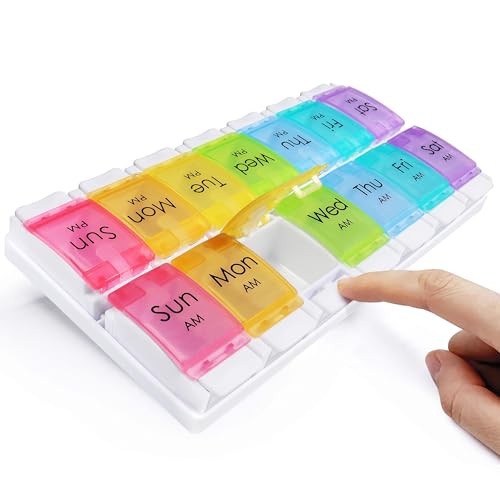
Pros
- 14 AM/PM compartments for twice-daily routines
- BPA-free plastic for long-term medication storage
- Each space fits up to 6 large fish oil pills
- 1.3 x 1.18 x 0.82 inch compartments add capacity
Cons
- Extremely large pills may not fit each compartment
- Two detachable rows may be misplaced when removed
- Push buttons may need cleaning around each lid

Pros
- 7-day layout helps organize a full week at once
- Each compartment holds up to 22 aspirin-sized pills
- Portable 7-day box fits travel bags for daily doses
Cons
- Medium compartments may be tight for large tablets
- Single weekly box lacks separate morning and evening slots
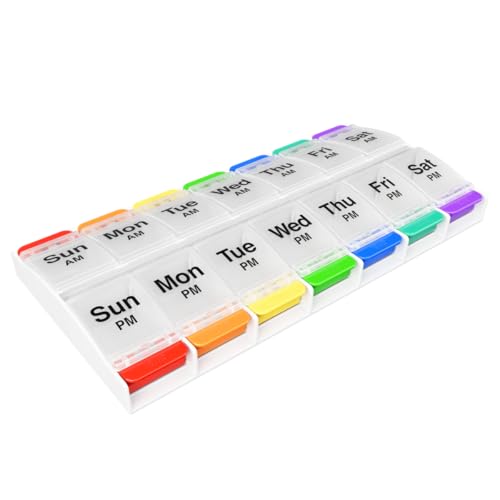
Pros
- 7-day AM/PM layout separates morning and evening doses
- Each oversized section holds up to 35 aspirin tablets
- Silicone feet grip the counter for one-handed access
- BPA-Free plastic supports repeated daily handling
Cons
- X-large case may take extra space in a travel bag
- Only AM/PM slots, not enough for midday doses

Pros
- 7-day layout supports a full week of sorting
- 4 compartments per day for multiple dose times
- ABS outer container adds extra pill protection
- BPA-free PP material for daily medicine storage
Cons
- Large 8 x 5 inch case may crowd small bags
- Four daily sections may be excessive for simple routines

Pros
- 7-day layout supports a full weekly medication routine
- BPA-free food-grade material for pill storage
- Spring-open lids use rubber strips for one-handed access
- 3M Tapes ink test helps printed labels last
Cons
- Single weekly case may not separate morning and night doses
- Push buttons may still require enough fingertip strength
- Large vitamins or cod liver oil capsules can fill slots fast
A Closer Look at Our Top Pick
For many families, the easiest place to start is the Sukuos AM PM because its layout matches a common 2-times-a-day routine without adding extra sections to manage. It has 14 compartments, arranged for morning and evening doses across 7 days, so a caregiver can sort a full week in one sitting. The push-button design is meant to require minimal force, which matters when small lids are frustrating or slow to open. Each compartment fits 8 fish oils or 9 vitamins, giving it enough room for larger supplements while still keeping the schedule simple.
The trade-off is size and schedule flexibility. At 9 x 4.5 inches, the case may feel bulky in a small handbag, and it only has 2 daily slots. If your parent takes medicine at midday too, a 4-times-a-day organizer may fit better. Still, for a person who mainly needs morning and evening separation, a 14-compartment AM PM organizer is a clear, low-fuss format that is easy for family members to check during a weekly refill.
Find Your Situation
- the Sukuos AM PM: suits a 7-day routine with 2 daily dose times and larger vitamins, since each section fits 8 fish oils or 9 vitamins. Watch out: the 9 x 4.5 inch case may crowd a small handbag.
- the MOLN HYMY Large: suits a 7-day AM PM setup where clear rainbow plastic and 14 compartments help a caregiver see contents. Watch out: the 2 detachable rows can be misplaced when removed.
- the Amazon Basic Care: suits a simple 7-day routine, with each compartment holding up to 22 aspirin-sized pills. Watch out: the single weekly box does not separate morning and evening doses.
- the Ezy Dose Weekly: suits people who need AM PM separation and oversized sections, with each section holding up to 35 aspirin tablets. Watch out: the X-large case may take extra room in a travel bag.
- the Daviky Pill Organizer: suits a 7-day schedule with 4 dose times per day, especially when removable daily boxes help with travel. Watch out: the 8 x 5 inch case may be more than a simple routine needs.
- the AUVON Weekly Pill: suits a 7-day routine where spring-open lids and push buttons may help with one-handed access. Watch out: it does not separate morning and night doses.
How We Narrowed It Down
We compared published specifications rather than handling the products, focusing on layouts that make sense for older adults and family caregivers. We included 7-day cases, 14-compartment AM PM cases, and a 4-times-a-day option because those cover common home routines. We excluded designs that did not give a clear weekly structure, did not list meaningful capacity details, or added complexity without a clear daily-dose benefit. We also looked for trade-offs, such as an 8 x 5 inch case that gives more sections but takes more bag space, or a single 7-day box that stays simple but cannot split morning and evening pills. If hand strength, vision, balance, or medication timing is changing, ask a doctor or physical therapist for practical setup advice, and the National Institute on Aging has plain guidance on home safety and routines at falls and falls prevention.
What to Look For
Match the organizer to the number of daily dose times
Start with the schedule, not the box. A 7-day case with 1 compartment per day can work when the person takes pills at one regular time. A 14-compartment AM PM case is better when morning and evening doses need to stay separate. If there are 4 dose times in a day, a 4-times-a-day organizer prevents different doses from sharing one space. The same schedule-first rule applies to pill dispensers for older adults.
Check whether the compartments fit the real pills
Capacity matters most when fish oil, cod liver oil, or large vitamins are part of the routine. Some weekly organizers hold up to 22 aspirin-sized pills per compartment, while oversized AM PM sections can hold up to 35 aspirin tablets. For large supplements, oversized AM PM compartments may be easier than squeezing capsules into medium spaces. If a slot fills to the top, it may be harder to see whether the right pills are inside.
Look for lids that open without a struggle
Small snap lids can be tiring when they are opened 7 times or 14 times during a refill. Push-button lids are useful when they need minimal force, and spring-open lids can help when one-handed access is important. A grippy base can also matter, because silicone feet help keep a case steady on the counter. Even with helpful lids, make sure the person has enough fingertip strength for the button style.
Before you buy, decide where it will live
A large case is easier to read and refill, but it may not travel well. A 9 x 4.5 inch organizer gives room for bigger pills, while an 8 x 5 inch organizer gives space for 4 sections per day. If your parent keeps medicine on a kitchen counter near a blood pressure monitor, size may be a fair trade-off. If the organizer needs to fit a purse or small travel bag, a simpler 7-day box may be easier to carry.
Make the refill process easy for the helper
A caregiver may prefer a layout that makes all 7 days visible at once. Clear compartments can help with a quick visual check, especially when there are 14 AM PM sections. Removable daily boxes can help when the person needs only 1 day away from home. For a multi-dose routine, a 4-times-a-day weekly case may reduce sorting mistakes by giving each dose time its own section.
When this is not enough, add human support
A pill organizer is only a container, and it cannot replace a medication plan from a clinician. If there are 4 daily dose times, changing instructions, or several helpers involved, write down who fills the box and who checks it. Families who need local aging services can contact Eldercare Locator or call 1-800-677-1116. That support can be useful when the routine needs more than a 7-day box.
Choose labels your parent can actually read
Day labels matter because the organizer is checked over and over during the week. Bold labels can help a 7-day layout feel less crowded, especially when the case has 14 or more sections. Printed labels should stay legible through regular handling, and durable ink testing can be a useful detail. If the person reads better with color cues, rainbow layouts may add another cue beyond the printed day.
Quick Tips for Choosing
- Use 1 daily compartment only for a simple once-a-day routine.
- Choose 14 compartments when morning and evening doses differ.
- Choose 4 sections per day when midday doses are part of the plan.
- Check large capsules before choosing medium compartments.
- Favor push-button or spring-open lids if small tabs are frustrating.
- Keep a travel box small enough for the bag used most often.
Frequently Asked Questions
What size pill organizer is easiest for an older adult?
The easiest size is the one that matches the routine with the fewest unused sections. A 7-day box can suit one daily dose, while a 14-compartment case suits morning and evening doses.
Is an AM PM organizer better than a basic weekly box?
An AM PM organizer is better when the person takes different pills 2 times a day. A basic 7-day box is simpler when all pills are taken at one daily time.
When should I choose a 4-times-a-day organizer?
Choose a 4-times-a-day organizer when the schedule includes morning, midday, evening, and bedtime doses. It gives each dose time its own place across 7 days.
Are large pill organizers harder to travel with?
They can be, especially when a case measures 9 x 4.5 inches or 8 x 5 inches. Larger cases offer more room, but they may crowd a small handbag or travel pouch.
How much capacity should I look for?
Look at the largest pills first, not the smallest tablets. Compartments that hold 22 aspirin-sized pills or 35 aspirin tablets may be helpful when vitamins or fish oil are included, or when using a pill crusher for seniors.
Do push-button lids help with hand comfort?
They may help when the button needs minimal force and the lid opens cleanly. The person still needs enough fingertip strength to press the button 7 or more times during a refill.
Are detachable trays useful?
Detachable trays can help when the person needs to take 1 day or 1 row away from home. The trade-off is that 2 removable rows or small daily boxes need a regular storage spot.
Should a caregiver refill the organizer every week?
A weekly refill works well for many 7-day organizers because all compartments can be checked at once. If instructions change often, confirm the schedule with the prescribing clinician before the next refill, or consider an automatic pill dispenser.
What if pills are taken at different times on different days?
A standard 7-day layout may still help, but the written schedule becomes more important. If there are several changes across the week, use a 4-times-a-day layout only when the sections match the actual dose times.
Can a pill organizer replace medication instructions?
No, it only separates pills into compartments. The medication list, label directions, and clinician instructions still guide what goes into each of the 7 days.
Which One to Start With
If your parent takes pills in the morning and evening, start with the Sukuos AM PM. Its 14-compartment layout covers 7 days without asking you to manage extra midday or bedtime spaces. It also has room for larger supplements, with each compartment fitting 8 fish oils or 9 vitamins, which helps when the routine includes bulky capsules. The main reason not to start there is size, since the 9 x 4.5 inch case may be too large for a small bag.
If the routine is once a day, choose a portable 7-day weekly box instead. It keeps the setup simple, and each compartment holds up to 22 aspirin-sized pills. That is a better fit when separating morning from evening would only add confusion.
If there are several dose times every day, start with the Daviky Pill Organizer. Its 4 compartments per day give morning, midday, evening, and bedtime pills separate spaces across 7 days. It is larger at 8 x 5 inches, so it is best for a counter or drawer rather than a small purse. For families who want the fewest decisions, choose by dose times first: 1 daily slot for simple routines, 2 daily slots for AM PM routines, and 4 daily slots when the schedule truly needs them.