

Getting up from a bed, chair, or toilet often takes 2 separate actions: shifting weight forward, then finding steady hand support while the legs do the rest. The best transfer poles for seniors give that support in a vertical line, so your parent can pull, push, or pause without reaching across the room. After comparing 3 floor to ceiling options, the Stander Double Handle stands out for its 2 adjustable handles and no-drill tension setup, while the Stander Wonder Pole is a simpler slim choice for flat 7 to 10 foot ceilings. The right choice depends on ceiling shape, transfer spot, and how much handle guidance the person needs.

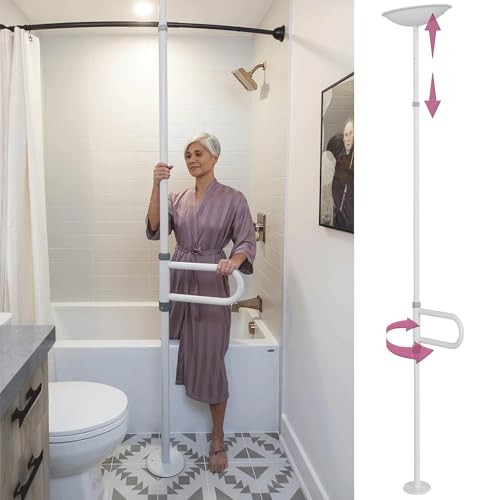
Pros
- 2 handles adjust by height and angle
- Steel frame supports up to 300 pounds
- Fits ceilings from 7 ft to 9 ft 6 in
- No-drill tension mount avoids wall holes
Cons
- Not compatible with vaulted ceilings
- Not for use inside bathtubs or showers
Pros
- Fits 7-10 ft ceilings without drilling into walls
- 14-inch pivot bar locks into 8 set positions
- 300 lb support rating for transfer assistance
- ISO 13485:2016 certification backs manufacturing
Cons
- Tension design may not suit sloped or fragile ceilings
- Floor-to-ceiling pole can obstruct narrow walkways
- 300 lb capacity may be limiting for larger users

Pros
- Supports up to 300 pounds for transfer assistance
- Adjusts to flat ceilings from 7 to 10 feet
- Tension mount needs 0 wall mounts or drilling
Cons
- Not compatible with vaulted or angled ceilings
- Cannot be used inside bathtubs or showers
A Closer Look at Our Top Pick
The Stander Double Handle is the first option I would consider for many homes because it gives the person 2 places to hold instead of 1. That matters when a transfer is not a single straight pull. A person may need one hand higher for standing and another lower or angled for turning toward a chair, toilet, or bed. The steel frame is rated to support up to 300 pounds, and the pole fits flat ceilings from 7 feet to 9 feet 6 inches. Its no-drill tension mount also makes sense for families who are trying to add support without putting holes in a wall.
The main limitation is placement. This is not a bathtub or shower pole, and it is not made for vaulted ceilings. It is best treated as a transfer aid beside a stable surface, not as a substitute for a full bathroom safety plan. Compared with a single padded handle, a no-drill pole with 2 adjustable handles gives more hand positions on paper, which can help when your parent needs a clear place to pause during a stand or sit. Before buying, measure the ceiling height and look at the floor space around the transfer path.
Find Your Situation
- the Stander Double Handle: suits a bed, chair, or toilet area where 2 adjustable handles could help the person stand, turn, or sit with support up to 300 pounds. Watch out: it fits ceilings only from 7 feet to 9 feet 6 inches and is not for vaulted ceilings.
- the HEALTHCRAFT uPole with: suits tight rooms where a 14 inch pivot bar that locks in 8 positions may help line up the handhold with the transfer path. Watch out: the floor to ceiling pole can obstruct narrow walkways, especially near a small bed or chair space.
- the Stander Wonder Pole: suits a flat ceiling from 7 to 10 feet when your parent needs a slim tension mounted pole for sitting, standing, or transfers. Watch out: it cannot be used inside bathtubs or showers and is not compatible with angled ceilings.
How We Narrowed It Down
We compared published specifications rather than handling the products, focusing on transfer poles that use floor to ceiling tension mounting, list a support rating, and give clear ceiling fit information. We excluded items that did not match the basic transfer pole format, products centered on wall mounting, and choices that did not provide enough placement detail for a careful home decision. The comparison gave extra weight to handle layout, ceiling range, no-drill installation, and stated limits such as 300 pound support ratings or restrictions for vaulted ceilings. If your parent has a recent change in strength, balance, pain, or transfer ability, ask a doctor or physical therapist where a pole should go and whether a different aid would be safer. The National Institute on Aging offers practical falls and falls prevention guidance that can help families think through home setup without guessing.
What to Look For
Start with the exact ceiling height
A transfer pole only makes sense if it fits the room before anyone tries to use it. The Stander Double Handle fits ceilings from 7 feet to 9 feet 6 inches, while the other 2 options listed here fit flat ceilings from 7 to 10 feet. Measure from the finished floor to the finished ceiling at the exact spot where the pole will stand. Do not assume every part of the room has the same height.
Check the ceiling shape before the handle style
All 3 options are tension mounted, so the ceiling shape is not a small detail. The Stander Double Handle and the Stander Wonder Pole are not compatible with vaulted or angled ceilings, and the HEALTHCRAFT option may not suit sloped or fragile ceilings. A flat ceiling gives the pole a more suitable surface for its tension design. If the ceiling is angled, choose another kind of support after getting professional guidance.
Match the handle to the movement
Think about what the person actually does during the transfer: stand straight up, pivot, lower slowly, or move between 2 surfaces. The Stander Double Handle has 2 adjustable handles that can be set by height and angle, while the HEALTHCRAFT model has a 14 inch pivot bar that locks in 8 positions. A simpler padded handle can still work when the transfer is straightforward. For more complex movement, a 14 inch pivot bar with 8 locking positions may be easier to align with the room.
Look hard at the walkway
A floor to ceiling pole helps only if it does not create a new obstacle. The HEALTHCRAFT pole notes that it can obstruct narrow walkways, which is worth taking seriously in a small bedroom or bathroom path. Leave enough space for the person, a caregiver if needed, and any mobility board or other mobility aid already used in the room. If the pole sits beside a bed, check both the standing space and the path around the bed.
Before you buy, decide where it will not go
Do not place these poles inside a bathtub or shower. Both the Stander Double Handle and Stander Wonder Pole state that they are not for use inside bathtubs or showers, and the products here are best understood as dry-area transfer supports for indoor use, separate from outdoor mobility options like recumbent trikes. A toilet area, bedside, or chair side location may be a better fit, depending on the room. If the bathroom is the concern, look at the whole path, not just 1 standing point.
When this is not enough, ask for local help
A pole is only 1 part of a transfer setup. If your parent needs hands-on help, has trouble following the same transfer steps, or needs support in more than 1 room, a single 300 pound rated pole may not answer the whole problem. The Eldercare Locator can connect families with local services, and the phone number is 1-800-677-1116. Local guidance can be especially useful when the home has tight rooms or several transfer spots.
Read the support rating as one limit, not the whole story
Each of the 3 products lists a 300 pound support rating for transfer assistance. That number is important, but it does not cover ceiling strength, installation quality, or whether the person can use the handle safely. The pole also needs to match the person’s reach and the direction of movement. If the person is close to the rating, consider asking a professional before choosing a tension mounted pole.
Quick Tips for Choosing
- Measure the exact ceiling height at the transfer spot.
- Use these only with flat ceilings when the product requires it.
- Keep the pole out of bathtubs and showers.
- Choose 2 handles when the transfer has more than 1 step.
- Check that the pole will not narrow the walking path.
- Respect the 300 pound support rating listed for each option.
Frequently Asked Questions
What is a transfer pole used for?
A transfer pole gives the person a vertical handhold for sitting, standing, or moving between nearby surfaces. For people with different mobility needs, wheelchairs for elderly users offer another support option. The models compared here are floor to ceiling poles with tension mounting and support ratings up to 300 pounds.
Can a transfer pole go in a shower?
Do not use these listed transfer poles inside a bathtub or shower. The product information for 2 options specifically says they are not for that location, so treat wet bathing areas as a separate safety question.
Do transfer poles need drilling?
The 3 products compared here use no-drill tension mounting. That can help renters or families who do not want wall holes, but the ceiling and floor still need to be suitable.
What ceiling height do these poles fit?
The listed ranges are 7 feet to 9 feet 6 inches for one option and 7 to 10 feet for the other 2 options. Measure the exact location before choosing, because a small difference can matter.
Can a transfer pole work with a vaulted ceiling?
The options here are not a good match for vaulted or angled ceilings. A tension pole needs the ceiling condition described by the product, and a sloped surface changes that setup.
Is a 300 pound rating enough?
A 300 pound support rating may be enough for some people and not enough for others. Also consider how the person transfers, whether a caregiver assists, and whether the ceiling and floor are suitable.
Where should a transfer pole be placed?
Common locations include beside a bed, chair, or toilet, depending on where the person needs hand support. The best location leaves a clear path and puts the handle where the person naturally reaches.
What is the difference between a fixed handle and a pivot bar?
A fixed or padded handle gives a simple grasp point, while a pivot bar can offer more directional placement. One option here has a 14 inch pivot bar that locks into 8 set positions.
Can one pole serve multiple rooms?
A no-drill pole can sometimes be moved, but it should be installed correctly every time. If the person needs support in 2 rooms every day, more than one support location may be easier and steadier.
Should a caregiver install the pole alone?
Follow the product instructions and check the ceiling range before installation. If there is any doubt about placement, ceiling condition, or the person’s transfer ability, ask a physical therapist or other qualified professional.
Which One to Start With
If you want the most broadly useful starting point for a dry bedside, chair side, or toilet area, start with the Stander Double Handle. The 2 adjustable handles give your parent more than 1 hand position, and the steel frame is rated up to 300 pounds. It also avoids drilling and fits ceilings from 7 feet to 9 feet 6 inches, which covers many standard rooms. I would choose it first when the person needs to rise, pause, and turn in a controlled way rather than simply grab 1 padded spot.
Choose the HEALTHCRAFT uPole with when the room layout makes handle direction especially important. Its 14 inch pivot bar locks in 8 positions, which can help line up the handhold near a bed, chair, or toilet in a tighter layout. The trade-off is space: a floor to ceiling pole can get in the way in narrow walkways, so map the walking path before buying.
If your parent needs a simpler slim pole and the ceiling is flat from 7 to 10 feet, a slim tension mounted pole with a padded handle is the cleaner place to start. It still carries a 300 pound support rating and uses no wall mounts or drilling. I would pick that route when the transfer is straightforward, the room is not cramped, and 1 handhold is enough.