

Walking becomes harder when balance falters or one leg needs extra support. A single cane helps, but only touches the ground at one point. A quad cane spreads that support across four feet, giving your parent or loved one a steadier base and more confidence with each step. After comparing the best quad canes for elderly shoppers, we narrowed the field to three models that balance stability, portability, and ease of use. The Rehand Quad Canes and Rehand Quad Cane both suit taller users and offer collapsible frames, while the KINGGEAR model brings lightweight simplicity to the category. Read on to find which one fits your situation.
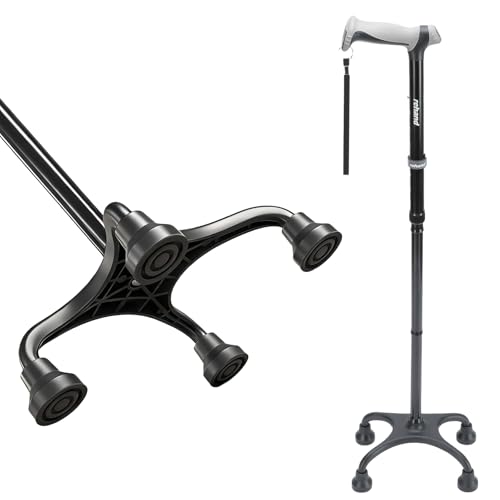
Pros
- Adjusts through 8 height increments for users 5' to 6'5" tall
- Molded base design improves stability versus traditional welded bases
- Collapses to 16" length and fits in briefcases or wheelchair bags
- Dual-material handle uses PP support with TPR comfort padding
- Works for both right and left-handed users
Cons
- Four-pronged base is wider than standard canes, needs more floor space
- Hard PP handle material may feel less forgiving during extended use
- Heavier quad design makes it less portable than single-point canes

Pros
- Molded base design avoids instability of traditional welded bases
- 8 adjustable height increments accommodate users up to 6'5"
- Extra handle provides assistance when rising from seated position
- Collapsible aluminum frame folds to 16" for transport or storage
- Hard PP and soft TPR handle materials balance support with comfort
Cons
- Four-pronged base requires more floor space than standard single-point canes
- Requires proper height adjustment to work effectively for the user
- Heavier than single-point canes due to broader base design

Pros
- Adjustable height range of 31-36 inches fits most seniors
- Lightweight at 1.1 lbs with 300 lb weight capacity
- EVA foam padded handle reduces hand fatigue during use
- Quad base design supports full weight and enables turning
Cons
- Four-point base makes cane bulkier than single-point models
- Foldable design may reduce overall structural rigidity
- Limited height range excludes very tall or short individuals
A Closer Look at Our Top Pick
The Rehand Quad Canes stand out because they adjust to fit a wide range of heights and collapse small enough to slip into a bag or wheelchair storage. The molded four-pronged base is stronger and more stable on paper than traditional welded bases, which can develop weak points over time. The dual-material handle combines a hard plastic core for structural support with a soft padded layer on the grip, so your parent gets both confidence and comfort. The cane works equally well for right or left-handed people, and the 8 height increments accommodate anyone from 5 feet to 6 feet 5 inches tall.
The main trade-off is floor space. The four-pronged base is wider than a single-point cane, so your parent will need a bit more room to maneuver in tight hallways, doorways, or crowded spaces. The weight is also higher than a standard single cane because the broader base design adds heft. But if your parent spends time moving between home, a car, and appointments, the ability to fold this cane down to just 16 inches and toss it into a bag is a genuine advantage. Many caregivers also appreciate that they can grab this cane and take it anywhere without planning ahead.
Find Your Situation
- if your parent is tall or height varies among family members using the same cane. Adjusts for users 5 feet to 6 feet 5 inches. Watch out: the four-pronged base needs extra floor space compared to single-point canes.
- if your parent struggles to stand up from a chair and needs an extra handle to push off. The molded base provides steady support while rising. Watch out: height must be set correctly or the cane won’t help your parent safely.
- if lightweight and simple is the priority, or your parent weighs under 300 pounds and is average height. Weighs just 1.1 pounds. Watch out: the height range of 31 to 36 inches doesn’t fit very tall or very short seniors.
How We Narrowed It Down
We compared published specifications and features of dozens of quad canes on the market, focusing on stability, adjustability, weight, and portability for seniors age 65 and older. We excluded single-point canes and rolling walkers, since they solve a different balance challenge. We also ruled out canes with non-adjustable heights, as one-size-fits-all designs often sit too high or too low and lose their benefit. We compared the materials listed for each handle and base to understand comfort and durability on paper. A conversation with a doctor or physical therapist can help your parent figure out whether a quad cane is the right tool or if a walker, gait belt, or other aid would work better. For more information on fall prevention and balance, visit the National Institute on Aging.
What to Look For
Height range that covers your parent’s actual height
A cane that sits too low forces your parent to lean forward and pinch their shoulder. Too high, and it throws off balance. The Rehand models adjust across 8 increments to fit anyone from 5 feet to 6 feet 5 inches, so most adults will find a setting that works. The KINGGEAR adjusts from 31 to 36 inches, which covers average adults but may leave very tall or petite seniors without a good fit. Always measure your parent from their wrist to the ground while they stand with arms at rest, then check the cane’s range before buying.
A base wide enough to feel stable but not so wide that it gets in the way
Four points of contact beat one point every time when balance is shaky. However, the quad base is bulkier than a single cane. The molded bases on both Rehand models are designed to be stronger than welded bases, which can crack or separate at joints. If your parent has a small apartment, a boat cabin, or moves between tight spaces, test-drive the cane in those spaces first. You can ask a store to set up a cane in the aisle so your parent can see how much room it takes to move around.
A handle that won’t make your parent’s hand ache
If your parent walks for 20 minutes or more, a hard plastic handle alone can create pressure points and fatigue. The Rehand canes use a two-layer approach, with a soft TPR padding over a harder PP core, which spreads pressure. The KINGGEAR uses EVA foam padding. Both designs reduce hand and wrist strain during longer walks. Ask your parent to grip the handle for a minute in the store, or order from a retailer with a good return policy.
Weight that your parent can lift and carry without strain
Quad canes are heavier than single-point canes because the base is broader and heavier. The KINGGEAR at 1.1 pounds is the lightest option here. The Rehand models are heavier due to their larger footprint, but both collapse to 16 inches, which makes carrying easier even if the weight is more. If your parent has arthritis in the hands or shoulders, the lighter weight of the KINGGEAR may matter more than the height range. A cane your parent won’t struggle to lift is a cane they’ll actually use every day.
Before you buy: Make sure your parent can stand and walk safely with supervision first
A quad cane helps, but it’s not a substitute for medical clearance. A doctor or physical therapist should confirm that your parent can bear weight on the leg that needs the cane and has enough balance to use it safely. Many insurance plans cover a session with a physical therapist to fit a mobility aid and teach proper technique. Ask your parent’s doctor for a referral, or contact Eldercare Locator to find local resources and support services in your area.
Adjustability that lets you set the height once and not worry about it
The best quad cane is useless if the height drifts or changes every time your parent uses it. The Rehand models use 8 discrete height increments, so once you find the right notch, it stays put. The KINGGEAR also adjusts in steps, not continuously, which is safer. Look for a locking mechanism that is easy for your parent to operate but stiff enough that daily use won’t knock the setting out of place.
When this is not enough: Knowing when to move to a walker or rolling aid
A quad cane works well when your parent can lean on it for balance and some weight relief but can still walk with one hand free and enough coordination to manage stairs or uneven ground. If your parent needs both hands to support their weight, tires easily after short walks, or frequently loses their footing even with a cane, a rolling walker or rollator may be safer. Talk to your parent’s doctor about the next step if a quad cane isn’t meeting their needs after a few weeks of use.
Quick Tips for Choosing
- Measure your parent from wrist to floor while standing in regular shoes before comparing height ranges.
- Test the cane on the surfaces where your parent walks most: carpet, tile, hardwood, and outdoor pavement.
- Check that the handle height and material feel comfortable in your parent’s dominant hand before committing.
- If your parent travels or moves between locations, prioritize models that collapse or fold down small.
- Ask about trial periods or return policies, since the right fit is personal and can’t always be judged before use.
- Store the cane in an easy-to-reach spot so your parent grabs it without thinking twice.
Frequently Asked Questions
Can my parent use a quad cane on stairs?
A quad cane is not ideal for stairs because your parent needs one hand on the rail and the other on the cane, leaving no hand for the quad cane. Most physical therapists recommend that your parent use the handrail alone, or use a walker that has handholds on both sides. If stairs are a regular challenge, talk to a therapist about modifications or equipment that fits better.
What is the difference between a quad cane and a regular cane?
A regular cane has one foot, so it only touches the ground at one point. A quad cane has four feet, so it touches at four points, offering a wider, more stable base. Quad canes are better for people with balance problems, weakness in one leg, or arthritis in the hip or knee. Regular canes work for people who just need a little extra help with balance or fatigue.
How much weight can a quad cane support?
The KINGGEAR model supports up to 300 pounds. The Rehand models do not list a specific weight limit, but quad canes are generally designed for partial weight support, not full weight bearing. If your parent needs to put most or all of their weight on the mobility aid, a walker or two-handed cane is safer and more appropriate.
Are there left-handed quad canes?
Yes. Both Rehand models are designed for either right or left-handed use, so your parent can hold them in whichever hand feels natural. The KINGGEAR design is also neutral. Always test the cane in your parent’s dominant hand to make sure the handle angle and grip feel right.
What does it mean that the base is molded instead of welded?
A molded base is cast as one piece, so there are no joints where the four feet meet the shaft. A welded base is made of separate pieces joined together by welding. Molded bases are generally more durable because they don’t have seams that can crack or separate over years of use. Both types work, but molded bases may last longer with regular use.
How do I know if the quad cane is the right height?
When your parent stands upright with the cane in their hand and arms at rest, the top of the handle should reach their wrist. Their elbow should bend at about a 20 to 30 degree angle. If the cane is too short, they’ll lean over. If too tall, their shoulder will pinch. A physical therapist can help set the right height the first time.
Can I adjust the quad cane at home, or do I need a professional?
Most quad canes adjust at home using a simple mechanism like a push-button or twist-lock. Check the product instructions for your specific model. If your parent is uncertain, a physical therapist can show them how to adjust it and confirm the height is safe. Some medical supply stores also offer fitting services for a small fee.
What surfaces work best for a quad cane?
Quad canes work well on smooth, flat surfaces like tile, linoleum, wood floors, and even pavement. They are less stable on thick carpet, gravel, sand, or wet surfaces. Test the cane on the surfaces your parent uses most before settling on it. Outdoor use may require walking slower or holding a railing if available.
How do I store a quad cane when it’s not in use?
Store the cane upright in a corner near where your parent spends most time, or hang it on a hook if the frame permits. Keep it visible and accessible so your parent doesn’t forget it or make a trip without it. A collapsible model can be stored in a closet, car, or bag for travel.
What should I do if the quad cane breaks?
Check the product warranty and contact the seller or manufacturer. Broken bases, handles, or locking mechanisms can usually be repaired or replaced. In the meantime, have a backup cane or walker on hand so your parent doesn’t go without mobility support. Most medical supply stores can provide a loaner or rental while repairs are made.
Which One to Start With
Choosing the right quad cane depends on your parent’s height, lifestyle, and how much support they need. If your parent is taller than average, varies in height from other family members who might share the cane, or spends time in different locations, are the safest bet. The 8-inch height range covers most adults, and the collapsible 16-inch frame means your parent can take it anywhere without planning. The dual-material handle balances support and comfort for longer walks. The main drawback is the wider footprint, which takes more room to maneuver. If your parent has a small home or apartment and rarely travels, this may feel awkward in tight spaces.
If your parent has trouble standing up from a sitting position and struggles more with the standing-to-walking transition than with walking itself, the adds an extra handle for pushing off from a chair or low surface. This second handle is a genuine advantage for seniors who spend a lot of time sitting and need a boost to get vertical. The molded base and height adjustments are identical to the Rehand Quad Canes. The main question is whether that second handle is worth the extra weight and bulk. If your parent rarely needs help standing, you’re paying for a feature they won’t use.
If lightweight and simplicity are the priorities, or if your parent is average height and doesn’t travel much, start with the . At 1.1 pounds, it’s the easiest to carry and least fatiguing on the hand and wrist. The EVA foam padded handle is comfortable, and the 300-pound weight capacity covers most adults. The trade-off is height range. If your parent is shorter than 5 feet 1 inch or taller than 6 feet 1 inch, the 31-to-36-inch range won’t fit them well. For an average-height senior who values simplicity and weight over range, this cane delivers what it promises. Start with whichever matches your parent’s height and daily life, and ask about return policies so you can swap it out if it doesn’t feel right after a week or two of use.